DISCOVERING A NATIONAL TREASURE
INTERVIEW WITH WU DO-NAN, 102-YEAR-OLD TAI CHI MASTER. Part 1 of a series
by Jou, Tsung Hwa
Each year the Tai Chi Foundation sponsors a Tai Chi tour to China, including
both a two-week stay in mainland China visiting Beijing, Zhenshou, Xian, and
Guanzhow, and trips to Hong Kong and Taipei, Taiwan. In 1985 while in Beijing,
we heard of a remarkable Master of Tai Chi, Master Wu Do-Nan, who is 102 years
old. We did not want to miss this opportunity to talk with a Tai Chi master who
had achieved such longevity. Using my personal contacts in China, we were able
with much difficulty to arrange a meeting with Master Wu through the Beijing
Institute of Physical Education. Master Wu is considered a "national treasure"
and as such is highly protected by 8 guards on the first floor of his apartment
building and more guards on the ninth floor where he and his wife live. The
meeting was arranged, and following in this and the next several issues of Tai
Chi Farm is information learned from Master Wu Do-Nan.
The Story of Master Wu Do-Nan
Master Wu was born January 23, 1884 to a wealthy Mongolian family in the Chin
Dynasty. He vas a very frail child, yellow and gaunt, prone to fits of coughing,
shortness of breath, and epileptic seizures. His family's high position allowed
his father to ask the dynasty ruler to heal his child.
The doctors diagnosed Wu Do-Nan as having been born with three devastating
diseases: a liver infection, tuberculosis, and epilepsy. They took the
challenge, and Wu Do-Nan began to show some improvement. After
three years, however, the doctors reached the limits of medical care, and
informed Wu Do-Nan's parents that only Tai Chi Chuan could now benefit the
child. Master Wu was then introduced to Wu Chien-Chyan (or Wu Jianquan),
founder of the Wu form, a variation of the Yang School of Tai Chi Chuan.
A Note on Wu Chien-Chyan
Wu Chien-Chyan can, be linked directly to Yang Lew-Shan, originator of Yang
Style Tai Chi Chuan. It is said that the famous Yang Lew-Shan taught Tai Chi
Chuan to three of the Royal Guards as well as to his two sons, Yang Yu and Yang
Chian.
Each of the three Royal Guards had high achievement in other martial arts, and
as to his ability, each learned only one aspect of Yangs Tai Chi Chuan:
hardness, softness, and Fa Chin, which is the power to throw people away.
According to legend, these three aspects are related to learning Yang Lew-Shan's
bones, tendons, and skin, respectively.
Yang Lew Shan's two sons, Yang Yu and Yang Chian, both learned all three aspects
of Tai Chi Chuan from their father and both were also teachers. Wu Chien-Yu, the
father of Wu Chien- Chyan, studied with both Yang Lew-Shan directly and Yang Yu,
and Wu Chien- Chyan learned from his father. Wu Chien-Chyan's postures are
described in The Tao of Tai Chi Chuan, p. 49.
The Training of Wu Do-Nan
So Master Wu Do-Nan was able to study with Wu Chien-Chyan, in a direct line from
Yang Lew-Shan, for 8 years beginning at age 9. Through Wu Do-Nan we were able to
learn something of the traditional teaching methods of Wu Chien-Chyan, founder
of the Wu style.
According to Wu Do-Nan, in those days training did not begin with Tai Chi form.
Instead, for the first 2 to 3 years, students worked exclusively on developing
strength and flexibility in the legs, practicing extensive horse stance
movements, stretching exercises and kicks similar to warm-up exercises practiced
by the Wu Shu teams of China or by Western gymnastics teams.
The training was so difficult and demanding under such a task-master as Wu
Chien-Chyan that Wu Do-Nan thought of suicide. He was already weak and sickly,
and this great suffering almost caused him to give up. Only by remembering his
Mongolian heritage and the strength of his race was he able muster the
enthusiasm to work harder to make great progress.
Wu Do-Nan remembers his greatest suffering when he had to stand with his back to
a post, one ankle tied to the post and both arms embracing it from behind. The
other leg was attached to a pulley and lifted to the highest position tolerable,
and he was left in this position for up to an hour. Each day, the leg was pulled
higher until it reached his forehead .and later behind his head. Such rigorous
training today among Tai Chi players is not widely accepted; however, without
good background and hard work to develop flexibility, high achievement will
never be reached. Once the body had become flexible, Master Wu was taught the
form, but this training was no less rigorous than before. Often one posture,
such as Ward Off, was maintained until it was perfected, up to an hour. Only
when one posture was perfected was a new posture learned. To learn an entire
form often required 2 years; there were no "crash courses." Once Master Wu
learned the form, practice involved stopping at each movement or posture to take
six deep breaths. The reader can calculate how long it would take Master Wu to
complete the 268 movement Yang style he had learned, stopping at each movement
for six deep breaths. After completing the form, Master Wu remembers being able
to literally pour sweat from his shoes, even in winter! All his illnesses were
purged in this great sweat, and Wu Do-Nan became rejuvenated.
After accomplishing the form, Wu Do-Nan learned push hands. First, he learned
the single-hand fixed-stance push-hands using the four directions: Ward Off,
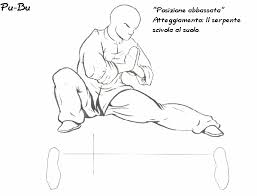
Roll Back, Press, and Push. Later, he learned two-handed push hands. The players
would lower their centers of gravity until they looked like two snakes
slithering on the ground.
Next, Wu Do-Nan learned Da Lu for the four corners: Split, Elbow, Shoulder
Strike, and Pull Down. The teacher would stand in the center and pull down the
student, forcing the student to run to the next corner to maintain his balance.
The teacher would balance the student's energy with his own, and would release
the students hands if his energy was too hard, causing him to fly away. Only
when the teacher felt the student had achieved a natural soft movement, like a
wind through the trees or like clouds across the sky, was the student allowed to
proceed to the next step, Relaxed Kung.
To achieve this relaxation, the student would stand for hours relaxing each part
of the body in turn, from the toes to the top of the head. The teacher was very
perceptive and could detect relaxation in any part of the body, only allowing
the student to pass on to another body part after relaxation had been achieved
in the previous part. When the body was totally relaxed, all the joints would
seem to be separated.
Application of each posture was the next step in training. The student learned
how to put power into each posture, beginning with the basic eight postures
(Ward Off, Roll Back., Press, Push, Split, Elbow, Shoulder- Strike, Pull Down),
and later with each posture of the solo form.
Chan Ssu Chin was then developed, enabling the whole body to move as a unit and
bringing the Chin to the fingers. The Chi Kung was practiced to accumulate Chi
in the Tan Tien, and the Chi was then pushed to the hands. Finally, Chi was
circulated to every part of the body.
After 8 years Wu Do-Nan had completed this course of study, and Master Wu
Chien-Chyan decided he had delivered all his knowledge and that Wu Do-Nan should
study with Yang Chao- Hsiung (or Yang Shaohou), the son of Yang Chian.


PD: Si, ya se que entrenaba usando qigong (yo no lo hago así)

 ?), los métodos de entrenamiento...